
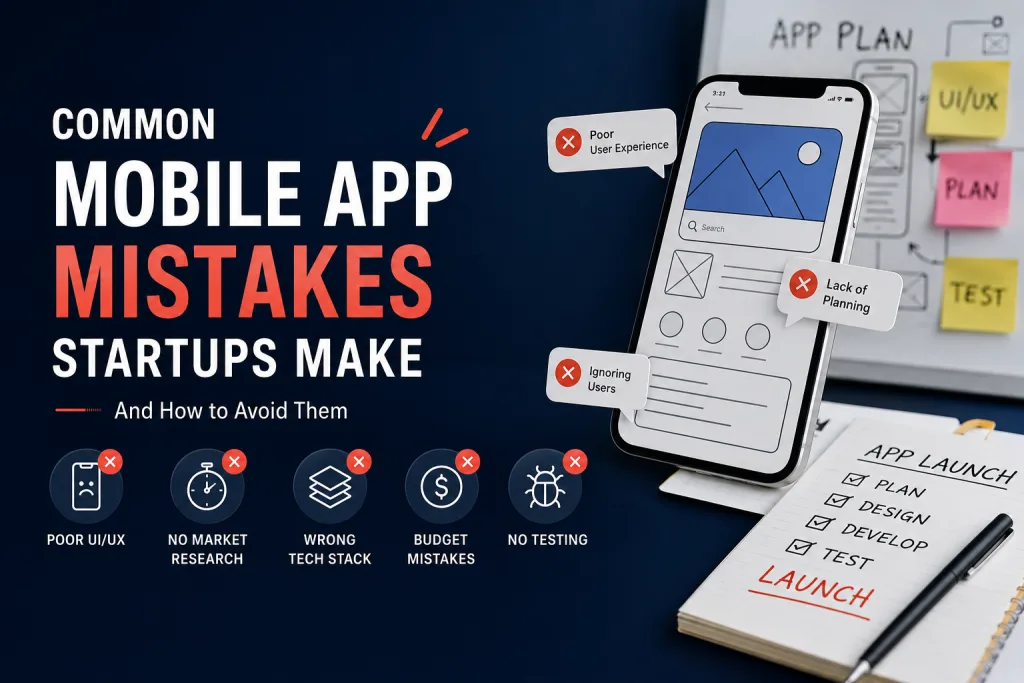
Building a mobile app can transform a startup into a scalable business. Some of today’s biggest technology companies started with a simple app idea and turned it into a global product. However, many startups fail not because the idea is weak, but because they make critical mobile app development mistakes early in the process.
From poor user experience decisions to choosing the wrong mobile app development stack, small mistakes can lead to lost users, wasted budgets, and failed launches.
If you are building your first application, understanding these common mobile app mistakes startups make can save time, money, and future headaches.
Why Startup Apps Fail More Than Founders Expect
One mistake startup founders make is assuming a great idea automatically creates a successful product.
The reality is different.
Many founders focus heavily on features while ignoring validation, usability, scalability, and long-term growth planning.
Some of the mistakes that kill startups include:
- Building products nobody needs
- Launching without market research
- Ignoring user experience
- Choosing the wrong technology stack
- Poor budgeting
- Lack of testing before launch
- Overcomplicating product development
Startups that avoid these problems significantly improve their chances of success.
1. Building Too Many Features Too Early
One common mistake too many tech startup founders make while building companies is trying to build everything at once.
Founders often think:
“More features mean more value.”
In reality:
More features often create:
- Higher development costs
- Longer launch timelines
- Poorer app performance
- Confusing user experiences
Instead, focus on building an MVP (Minimum Viable Product).
Your MVP should solve one major problem exceptionally well before adding extra functionality.
Better approach:
Focus on:
- Core functionality
- User feedback
- Iterative updates
- Performance optimization
Simple products often win.
2. Ignoring User Experience (UI/UX)
Many mobile apps fail because of bad design.
Mobile apps with bad UI frustrate users and increase uninstall rates.
Common UI mistakes include:
- Slow navigation
- Cluttered screens
- Poor onboarding experience
- Small buttons
- Confusing menus
- Lack of accessibility optimization
Users decide whether they like your app within seconds.
A clean interface improves:
- User retention
- Engagement
- Reviews
- Conversion rates
Signs your mobile app has bad UI:
✔ High bounce rates
✔ Low retention rates
✔ Poor app reviews
✔ Users abandoning onboarding
Good design is not decoration.
Good design drives growth.
👉 Learn more about UI/UX and development solutions:
3. Choosing the Wrong Mobile App Development Stack
Your mobile app development stack affects speed, scalability, maintenance costs, and future growth.
Many startups choose technology based only on trends.
That creates long-term problems.
Popular stacks include:
Native Development
For iOS:
- Swift
For Android:
- Kotlin
Best for:
- High performance apps
- Premium user experiences
Cross-Platform Development
Popular frameworks:
- Flutter
- React Native
Best for:
- Faster development
- Lower startup costs
- Wider device compatibility
Backend Technologies
Examples:
- Node.js
- Python
- Firebase
- PostgreSQL
The wrong stack can create:
- Higher infrastructure costs
- Slower updates
- Scaling issues
- Technical debt
Choose technology based on business goals, not hype.
👉 See our development capabilities
4. Launching Without Market Validation
One of the biggest mobile app development mistakes to avoid is building before validating demand.
Founders often spend months building products nobody wants.
Before development begins:
Ask:
- Does this solve a real problem?
- Who is the target audience?
- Are competitors already solving this better?
- Will users pay for this solution?
Validation methods:
- Landing pages
- Surveys
- Beta programs
- Waitlists
- Prototype testing
Validate first.
Build second.
5. Underestimating Development Costs
Many startups search for an affordable mobile app development service and immediately choose the cheapest option.
Low pricing alone does not guarantee value.
Cheap development often creates:
- Security vulnerabilities
- Poor performance
- Technical debt
- Redesign expenses later
Instead of focusing only on affordability, prioritize:
How to choose a mobile app development service
Look for:
✔ Portfolio quality
✔ Technical expertise
✔ Communication process
✔ Scalability planning
✔ UI/UX capability
✔ Post-launch support
The right development partner reduces long-term costs.
👉 Request a project consultation
6. Skipping Testing Before Launch
Many startups rush development.
That creates bugs.
Bugs destroy trust.
Testing should include:
Functional Testing
Ensures features work properly.
Performance Testing
Measures speed and responsiveness.
Security Testing
Protects user data.
Device Compatibility Testing
Ensures consistent performance across devices.
Quality assurance should never be optional.
7. Ignoring AI Opportunities
Artificial intelligence is reshaping software development.
Many startups now ask:
What are the essential steps to launch AI models?
If your product includes AI capabilities:
Key steps include:
- Define business objectives
- Collect quality data
- Train and validate models
- Optimize infrastructure
- Deploy securely
- Monitor performance continuously
AI integration requires planning.
Poor implementation creates poor experiences.
Smart implementation creates competitive advantages.
8. Not Planning for Scalability
Your startup may begin with 100 users.
But what happens when it reaches 100,000?
Scalability planning matters.
Areas startups often ignore:
- Database optimization
- Infrastructure scaling
- Cloud architecture
- API performance
- Security growth planning
Scaling problems can destroy momentum.
Build with future growth in mind.
9. Learning Mobile App Development Without Understanding Business Goals
Learning mobile app development is valuable.
But technology alone does not create successful companies.
Founders should understand:
- Customer psychology
- Product strategy
- User retention
- Market positioning
- Growth systems
Technology supports business.
Business strategy drives success.
10. Building Without Analytics
Data improves products.
Without analytics, founders operate blindly.
Track:
- User retention
- Session duration
- Feature adoption
- Conversion rates
- Crash reports
Analytics reveal what users actually do — not what founders assume.
Final Thoughts
Building a successful startup app requires more than development skills.
The most successful founders avoid common mobile app mistakes startups make by focusing on validation, user experience, scalability, and strategic execution.
Avoid shortcuts.
Choose the right mobile app development stack.
Prioritize strong UI.
Validate demand before building.
And invest in quality development from the beginning.
The startups that win are rarely the ones that build the fastest.
They are the ones that build the smartest.
About Evanic Freelancing Solutions
Evanic Freelancing Solutions helps businesses, startups, and entrepreneurs build scalable digital products through mobile app development, website development, digital growth solutions, and technology services designed for modern businesses.
Ready to build your next digital product? Start with strategy first.

 English
Looking for onbet333? This platform at judibola828bet.com is on point! Solid experience overall. Give it a shot. onbet333
This is informative.
Just launched my startup and this was quite helpful.
Thank you