
How SEO Helps Small Businesses Grow, Reach More Customers and Increase Sales
SEO for small businesses is one of the most effective ways to increase online visibility, attract potential customers, generate qualified leads and build long term growth. By optimizing a website and its content for relevant search queries, a small business can appear when people are actively looking for the products or services it provides.
Unlike paid advertising, where traffic generally stops when the advertising budget runs out, SEO can continue generating organic traffic after the initial optimization and content work has been completed.
How Does SEO Help Small Businesses?
SEO helps small businesses by making their websites easier to discover in search engines. A strong SEO strategy can help a business reach customers who are already searching for its products, services or solutions.
The main benefits include:
- Increased organic website traffic
- Greater online visibility
- More qualified leads
- Increased brand awareness
- Improved website experience
- Higher chances of appearing for relevant searches
- More opportunities to compete with established businesses
- Long term organic traffic growth
- Better understanding of customer search behavior
The value of SEO comes from reaching people at the right moment: when they have a question, need a solution or are ready to make a purchase.
Why Is SEO Important for Small Businesses?
SEO is important for small businesses because customers increasingly use search engines to discover businesses, compare options, research products and find solutions to problems.
A business can have excellent products or services, but if potential customers cannot find its website when searching for those services, it can lose opportunities to competitors.
For example, imagine a company that provides professional website development.
Someone searches for:
“website development company for small businesses”
If the company’s website has strong SEO and relevant content, it has an opportunity to appear in the search results and introduce its services to that potential customer.
This makes SEO more than a traffic strategy. It can become a customer acquisition channel.
How Does SEO Help Small Businesses Get More Customers?
SEO helps businesses attract customers by connecting their website with relevant search intent.
People search for different reasons. Some are looking for information, while others are comparing solutions or preparing to buy.
For example:
Informational search:
“What should a business website include?”
Commercial investigation:
“Best website development companies for small businesses”
Transactional search:
“Hire a website developer”
Each search represents a different stage of the customer’s decision making process.
A good SEO strategy creates useful content for these different stages and guides visitors toward the appropriate next step.
That next step could be:
- Requesting a quote
- Booking a consultation
- Calling the business
- Sending an inquiry
- Purchasing a product
- Signing up for a service
- Downloading a resource
1. SEO Increases Organic Visibility
One of the biggest benefits of SEO for small businesses is increased visibility in search results.
When a website is properly optimized, it can rank for relevant keywords and questions related to the company’s products or services.
For example, a digital marketing company could target searches such as:
- digital marketing services
- SEO services for small businesses
- how to improve Google rankings
- small business SEO strategies
- local SEO services
The goal is not simply to rank for as many keywords as possible.
The goal is to appear for searches that are relevant to the business and likely to attract the right audience.
2. SEO Attracts People Who Are Already Looking for Your Services
SEO can be particularly valuable because it captures existing demand.
Consider the difference between these two situations.
Someone sees an advertisement for a website development service while browsing social media.
Another person searches:
“How much does it cost to build an ecommerce website?”
The second person has already demonstrated interest in website development.
SEO allows businesses to create content that addresses these existing searches.
This can increase the likelihood of attracting visitors with genuine interest in the company’s products or services.
3. SEO Helps Small Businesses Compete With Larger Companies
Small businesses often cannot compete with large corporations on advertising budgets alone.
SEO provides another opportunity.
A smaller company can compete by creating highly relevant, useful and focused content around specific topics.
Instead of trying to rank immediately for a broad term such as:
“digital marketing”
a small business might target a more specific search such as:
“SEO for ecommerce businesses”
or:
“local SEO for restaurants”
More specific searches often have a clearer intent and can be easier to target than extremely broad keywords.
This approach is commonly known as targeting the long tail of search demand.
4. Local SEO Helps Small Businesses Reach Nearby Customers
For businesses that serve specific locations, local SEO can be especially important.
Local SEO helps businesses become more visible when people search for products and services in a particular area.
Examples include:
- Web designers near me
- Digital marketing agency in Lagos
- Best restaurant in Osogbo
- Plumber near me
- Accounting firm in London
A local SEO strategy can include optimizing the business website, maintaining accurate business information, developing location relevant content and building legitimate local authority.
For businesses with physical locations or defined service areas, local search visibility can translate directly into calls, visits, inquiries and bookings.
5. SEO Builds Trust and Credibility
Search visibility can contribute to how potential customers perceive a business.
When someone repeatedly encounters a company while researching a particular subject, that company can become more familiar to them.
Trust can be strengthened further through:
- Helpful educational content
- Case studies
- Customer testimonials
- Author information
- Clear company information
- Demonstrated expertise
- Original research
- Portfolio examples
- Transparent service information
A business should therefore avoid treating SEO as simply inserting keywords into web pages.
The strongest SEO strategy combines search visibility with genuine evidence that the business understands its field.
6. SEO Can Generate Leads Without Paying for Every Click
Organic search traffic does not work exactly like paid advertising.
With pay per click advertising, businesses generally pay when users interact with their advertisements according to the advertising platform’s pricing model.
Organic search traffic is generated through unpaid search listings.
That does not mean SEO is free.
SEO requires investment in areas such as:
- Strategy
- Technical optimization
- Content
- Website development
- Keyword research
- Digital PR and link acquisition
- Analytics
- Ongoing optimization
However, successful SEO can create an asset that continues attracting search traffic instead of requiring a new advertising payment for every visitor.
7. SEO Improves the Website Experience
Good SEO increasingly overlaps with good website design.
Search engines need to understand a website, but users also need to navigate it easily.
SEO improvements can encourage businesses to address issues such as:
- Slow page loading
- Poor mobile usability
- Confusing navigation
- Missing information
- Weak internal linking
- Poorly structured content
- Broken links
- Duplicate content
- Unclear page titles
- Poorly optimized images
These improvements can benefit both search visibility and website visitors.
A website that attracts thousands of visitors but provides a frustrating experience may still generate poor business results.
8. SEO Helps Businesses Understand Their Customers
Search data can reveal what potential customers actually want.
For example, a business may discover that its audience frequently searches for:
“How much does an ecommerce website cost?”
That information can influence the company’s content, service packages and sales strategy.
Another company might discover searches such as:
“How to improve website conversion rate”
This could reveal an opportunity to create educational content around conversion optimization and introduce relevant services.
SEO therefore provides more than traffic.
It can provide insight into customer questions, problems and purchasing behavior.
9. SEO Supports Long Term Business Growth
SEO is generally a long term strategy.
A newly published page may not generate significant organic traffic immediately. Rankings can take time to develop, especially in competitive industries.
However, a well optimized website can accumulate valuable content and authority over time.
For example:
Month 1: Technical SEO improvements and keyword research
Month 2: Publish targeted content
Month 3: Improve existing pages and internal linking
Month 4: Build authority and publish additional content
Month 5 onward: Analyze performance and continuously optimize
The exact timeline varies by industry, competition, website authority, content quality and many other factors.
Businesses should therefore evaluate SEO based on sustained growth rather than expecting instant results.
How Long Does SEO Take to Work for a Small Business?
There is no universal timeframe for SEO.
Some pages can begin receiving search visibility relatively quickly, while competitive keywords can require substantially more time.
Factors that influence SEO performance include:
- Website authority
- Competition
- Content quality
- Search intent
- Technical SEO
- Backlink profile
- Website history
- Industry
- Geographic targeting
- Search demand
- Consistency of optimization
Instead of promising a specific ranking within a fixed number of days, businesses should monitor measurable indicators such as organic traffic, keyword visibility, impressions, qualified leads and conversions.
How Much Does SEO Cost for a Small Business?
The cost of SEO depends on the scope of work and the competitiveness of the market.
A small local business may require a different strategy from an ecommerce company targeting customers internationally.
SEO costs can include:
- SEO audits
- Keyword research
- Technical SEO
- On page optimization
- Content creation
- Local SEO
- Link building
- Conversion optimization
- Analytics and reporting
- Ongoing strategy and optimization
The most important consideration is not simply the price of an SEO service.
Businesses should evaluate what is actually included, how success will be measured and whether the strategy is aligned with their commercial goals.
What SEO Strategies Should Small Businesses Use?
A strong small business SEO strategy should combine several areas of optimization.
1. Keyword Research
Identify the questions, problems, products and services your target customers search for.
Focus on search intent rather than simply selecting keywords with high search volume.
2. On Page SEO
Optimize important elements such as:
- Page titles
- Headings
- Content
- URLs
- Images
- Internal links
- Meta descriptions
- Relevant keywords
3. Technical SEO
Make sure search engines can efficiently crawl, understand and index the website.
Technical SEO can include:
- Mobile optimization
- Site speed
- Crawlability
- Indexation
- XML sitemaps
- Canonicalization
- HTTPS
- Structured data
- Core Web Vitals
4. Helpful Content
Create content that answers genuine customer questions.
Instead of producing articles purely to target keywords, provide clear explanations, examples, comparisons, original insights and practical solutions.
5. Local SEO
For location based businesses, optimize the website and relevant business profiles for local searches.
6. Internal Linking
Connect related pages so users and search engines can discover important content more easily.
For example:
A blog article about SEO for small businesses can link to an EFS Digital Marketing Services page.
7. Authority Building
Earn relevant mentions and links from credible websites, publications, organizations and industry resources.
Quality and relevance matter more than simply collecting a large number of links.
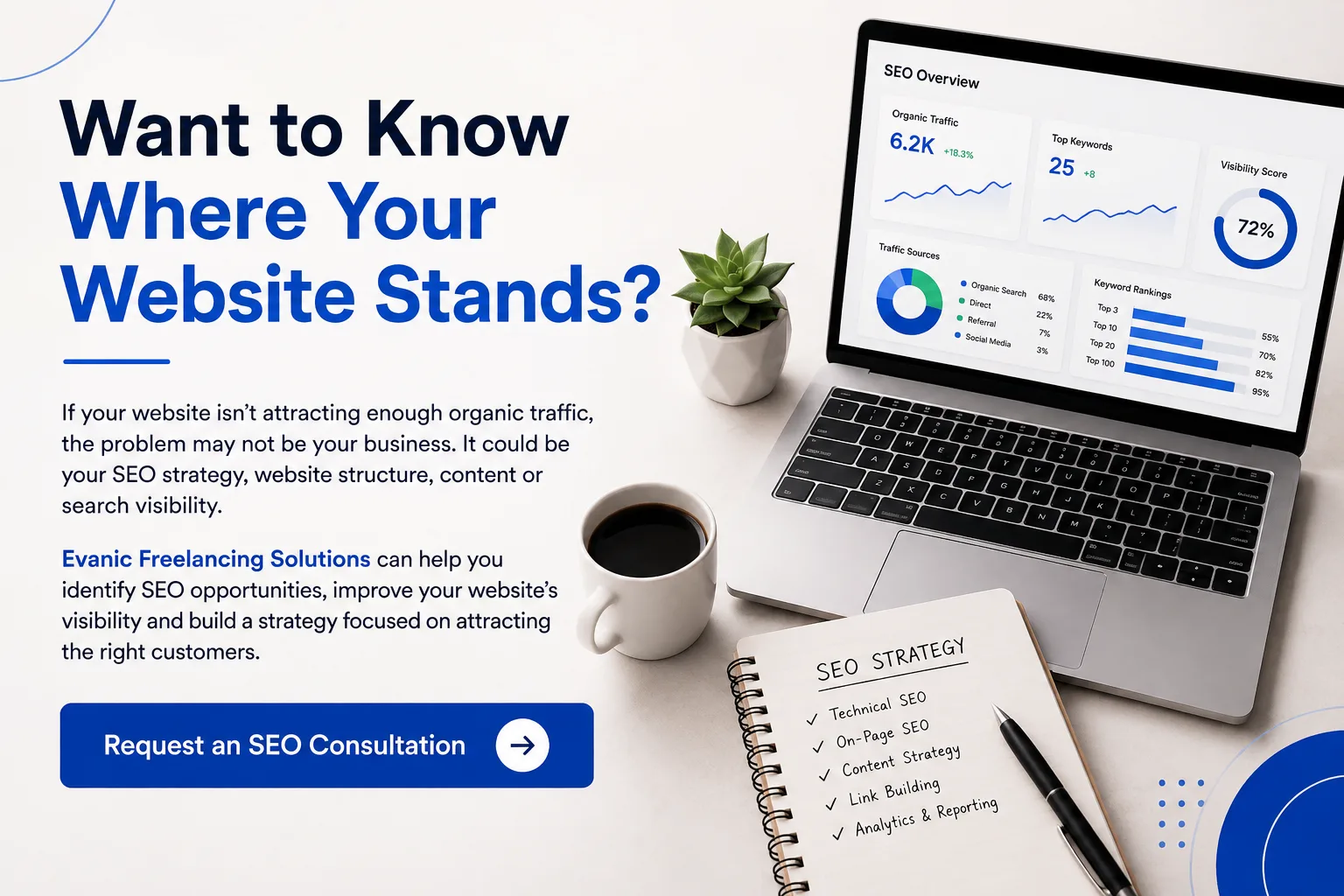
Want to Know Where Your Website Stands?
If your website isn’t attracting enough organic traffic, the problem may not be your business. It could be your SEO strategy, website structure, content or search visibility.
Evanic Freelancing Solutions can help you identify SEO opportunities, improve your website’s visibility and build a strategy focused on attracting the right customers.
SEO vs Paid Advertising: Which Is Better for Small Businesses?
Neither SEO nor paid advertising is automatically better for every business.
They serve different purposes.
| SEO | Paid Advertising |
|---|---|
| Builds organic visibility | Provides paid visibility |
| Can produce long term traffic | Can produce traffic quickly |
| Requires ongoing optimization | Requires ongoing advertising spend |
| Targets organic search demand | Provides control over ad targeting |
| Results can take time | Results can appear quickly |
| Builds a long term content asset | Useful for immediate campaigns |
For many businesses, combining both approaches can be effective.
Paid advertising can help generate immediate traffic while SEO builds sustainable organic visibility.
Common SEO Mistakes Small Businesses Should Avoid
Small businesses often make SEO more complicated than necessary.
Some common mistakes include:
Targeting Only High Volume Keywords
High search volume does not automatically mean high business value.
A keyword with fewer searches but strong purchase intent may generate more valuable customers.
Keyword Stuffing
Repeating the same keyword excessively can make content unnatural and difficult to read.
Write for people first while making the topic and context clear to search engines.
Ignoring Mobile Users
A large portion of online searches occur on mobile devices.
Your website should provide a fast, usable experience across different screen sizes.
Publishing Content Without a Strategy
Publishing dozens of unrelated articles does not necessarily create topical authority.
Content should support your audience, business objectives and overall website structure.
Buying Low Quality Backlinks
Large quantities of irrelevant or manipulative links can create risk rather than meaningful authority.
Focus on earning relevant, trustworthy references.
Expecting Immediate Results
SEO is not normally an overnight marketing solution.
It requires research, implementation, measurement and continuous improvement.
A Simple SEO Plan for a Small Business
A small business can begin with a practical six step process.
Step 1: Identify your target customers
Understand who you want to attract and what problems they need to solve.
Step 2: Research relevant searches
Find the questions, services and products your audience searches for.
Step 3: Optimize important website pages
Improve your homepage, service pages, product pages and other commercially important pages.
Step 4: Create useful content
Answer customer questions through articles, guides, comparisons and resources.
Step 5: Build authority
Earn relevant mentions, links and partnerships within your industry.
Step 6: Measure and improve
Track organic traffic, impressions, rankings, leads and conversions, then improve the pages producing the most opportunities.
Frequently Asked Questions About SEO for Small Businesses
Is SEO worth it for a small business?
Yes. SEO can be valuable for small businesses that want to build organic visibility, attract people searching for their services and generate long term website traffic. The potential value depends on the business model, competition, search demand and quality of the SEO strategy.
Can SEO help a new business?
Yes. A new business can use SEO to build search visibility by targeting relevant topics, creating useful content and optimizing its website. New websites may need time to establish authority, so expectations should be realistic.
Can a small business compete with large companies on Google?
Yes. Small businesses can compete for relevant searches by targeting specific topics, geographic areas, customer needs and long tail keywords. Competing effectively requires understanding search intent and creating better, more useful content rather than trying to target every broad keyword.
Does SEO increase sales?
SEO can contribute to sales by bringing relevant visitors to a website, but rankings and traffic alone do not guarantee revenue. The website must also provide a strong user experience, compelling offers, clear calls to action and an effective conversion process.
What is the most important SEO strategy for a small business?
There is no single strategy that works for every business. A strong foundation usually includes technical SEO, search intent focused keyword research, useful content, optimized commercial pages, internal linking, authority building and conversion optimization.
Can I do SEO myself?
Yes. Small businesses can handle basic SEO themselves, particularly tasks such as optimizing page titles, improving content, creating useful resources and fixing obvious website issues. More technical or competitive SEO may require specialist expertise.
Final Thoughts
SEO helps small businesses become easier to discover when potential customers are actively searching for information, products and services.
The most effective approach is not to chase rankings for their own sake. Instead, focus on understanding what your customers need, creating genuinely useful content, building a technically sound website and making it easy for visitors to take the next step.
When these elements work together, SEO can become a long term source of organic traffic, qualified leads, brand visibility and business growth.
For small businesses looking to improve their online presence, the right SEO strategy should begin with the customer rather than the keyword.
Ready to Grow Your Business With SEO?
Getting found online starts with having the right SEO strategy.
Whether you’re launching a new business, struggling to generate organic traffic or competing against established companies, Evanic Freelancing Solutions can help you build a stronger search presence.
Our SEO and digital marketing services are designed to help businesses improve search visibility, attract qualified visitors and turn website traffic into meaningful business opportunities.
Don’t leave your potential customers to your competitors.
Let’s build an SEO strategy around your business goals, your customers and the searches that matter to your growth.
Evanic Freelancing Solutions helps businesses improve their online presence through SEO, website development, digital marketing and conversion focused digital solutions.

 English